
GHRP-6
Synthetic hexapeptide growth hormone-releasing peptide (ghrelin receptor agonist); used in research diagnostic testing with GHRH; FDA compounding Category 2 (immunogenicity, possible cortisol and glucose effects).
60-Second Scientific Briefing
GHRP-6 is a synthetic six-amino-acid peptide that mimics ghrelin and stimulates growth hormone release; it also increases appetite. It is not approved as a medicine. In human research it has mainly been used, together with GHRH, as a diagnostic test for growth hormone deficiency (Lancet 2000). The FDA keeps GHRP-6 in Category 2 of its compounding list because of immunogenicity risk and possible effects on cortisol and blood glucose. It is prohibited in sport.
🛒 GHRP-6 products in the store (1) →
What is GHRP-6?
Pharmacological Classification & Molecular IdentityGHRP-6 is a synthetic hexapeptide growth hormone-releasing peptide that acts like ghrelin. [1] The Lancet, 2000 ↗
Verified Chemical & Regulatory Registry Identifiers
Mechanism of Action & Receptor Targets
Biological Pathway and Target BindingReceptor Selectivity: Activates the ghrelin (growth hormone secretagogue) receptor; combined with GHRH it is one of the most potent known stimuli of growth hormone secretion, which is why it was studied as a diagnostic test. [1] The Lancet, 2000 ↗
Regulatory & FDA Approval Status
Legal and Regulatory ClassificationsNot approved by the US FDA or other major regulators. The FDA lists GHRP-6 in Category 2 of its compounding-risk list, citing immunogenicity risk for some routes and possible effects on cortisol and blood glucose. Prohibited at all times by WADA (S2.2.4). [1] U.S. Food and Drug Administration, 2026 ↗ [2] World Anti-Doping Agency, 2024 ↗
GHRP-6 is not approved for commercial sale, prescription therapy, or compounded medication distribution. It exists strictly within authorized scientific and clinical research frameworks.
Human Evidence & Clinical Trials
Clinical Study Readouts and Evidence SynthesesDiagnostic study (Lancet 2000): 125 adults with organic pituitary disease and 125 healthy controls received intravenous GHRH plus GHRP-6, compared with the insulin tolerance test, to diagnose severe adult growth hormone deficiency. Other human studies measured hormone responses in conditions such as hypothyroidism and diabetes. No trial has shown therapeutic benefit. [1] The Lancet, 2000 ↗
Clinical Evidence
Diagnostic study (Lancet 2000): 125 adults with organic pituitary disease and 125 healthy controls received intravenous GHRH plus GHRP-6, compared with the insulin tolerance test, to diagnose severe adult growth hormone deficiency. Other human studies measured hormone responses in conditions such as hypothyroidism and diabetes. No trial has shown therapeutic benefit.
Safety Profile & Clinical Limitations
Documented Adverse Events and Known UncertaintiesThe FDA cites immunogenicity risk and possible increases in cortisol and blood glucose. It also increases appetite. No long-term safety dataset exists. [1] U.S. Food and Drug Administration, 2026 ↗
Safety of repeated use, effects on glucose and cortisol over time, and the quality of non-pharmaceutical material are unknown. [1] U.S. Food and Drug Administration, 2026 ↗
Dose Approval Status
Commercial Dosing Status and Policy DirectivesNo dose is approved or established. Amounts used in the published human studies are part of each study's design and are described in the linked papers; they are not a recommendation. [1] The Lancet, 2000 ↗
Under Egypt Peptides medical governance policies, no personal dosages, titration intervals, cycles, stacking recommendations, or self-injection instructions may be provided for unapproved investigational compounds. Clinical study protocols represent controlled experimental research parameters exclusively.
What is Known vs. What is Unknown
Evidence Comparison and Clinical Evidence Boundaries✓ Confirmed Scientific Evidence
- GHRP-6 is a synthetic hexapeptide growth hormone-releasing peptide that acts like ghrelin.
- Targets & Selectivity: Activates the ghrelin (growth hormone secretagogue) receptor; combined with GHRH it is one of the most potent known stimuli of growth hormone secretion, which is why it was studied as a diagnostic test.
- Diagnostic study (Lancet 2000): 125 adults with organic pituitary disease and 125 healthy controls received intravenous GHRH plus GHRP-6, compared with the insulin tolerance test, to diagnose severe adult growth hormone deficiency. Other human studies measured hormone responses in conditions such as hypothyroidism and diabetes. No trial has shown therapeutic benefit.
- Safety considerations: The FDA cites immunogenicity risk and possible increases in cortisol and blood glucose. It also increases appetite. No long-term safety dataset exists.
? Unknown / Under Ongoing Investigation
- Safety of repeated use, effects on glucose and cortisol over time, and the quality of non-pharmaceutical material are unknown.
Verified Questions & Answers
10 Verified scientific answers with permanent anchor keysGHRP-6 is a synthetic six-amino-acid peptide that mimics ghrelin, stimulates growth hormone release and increases appetite. It is not an approved medicine.
- GH-releasing hormone and GH-releasing peptide-6 for diagnostic testing in GH-deficient adults (The Lancet, 2000-09-30)
It activates the ghrelin (growth hormone secretagogue) receptor; together with GHRH it is one of the strongest stimuli of growth hormone release.
- GH-releasing hormone and GH-releasing peptide-6 for diagnostic testing in GH-deficient adults (The Lancet, 2000-09-30)
No. It is not approved, and the FDA keeps GHRP-6 in Category 2 of its compounding-risk list because of immunogenicity and possible cortisol and blood-glucose effects.
- Certain bulk drug substances for use in compounding that may present significant safety risks (U.S. Food and Drug Administration, 2026-04-22)
- The Prohibited List (World Anti-Doping Agency, 2024-01-01)
Human research has mainly used it with GHRH as a diagnostic test for growth hormone deficiency (Lancet 2000, 125 patients and 125 controls). No trial has shown a therapeutic benefit.
- GH-releasing hormone and GH-releasing peptide-6 for diagnostic testing in GH-deficient adults (The Lancet, 2000-09-30)
The FDA cites immunogenicity risk and possible rises in cortisol and blood glucose; it also increases appetite. No long-term safety data exist.
- Certain bulk drug substances for use in compounding that may present significant safety risks (U.S. Food and Drug Administration, 2026-04-22)
Safety of repeated use, long-term effects on glucose and cortisol, and the quality of non-pharmaceutical material are unknown.
- Certain bulk drug substances for use in compounding that may present significant safety risks (U.S. Food and Drug Administration, 2026-04-22)
No dose is approved or established. Amounts used in the published human studies are part of each study's design and are described in the linked papers; they are not a recommendation.
- GH-releasing hormone and GH-releasing peptide-6 for diagnostic testing in GH-deficient adults (The Lancet, 2000-09-30)
There is no approved product label, so no official storage instructions exist.
Yes. GHRP-6 is prohibited at all times under section S2.2.4 (growth hormone secretagogues and releasing factors) of the 2026 WADA Prohibited List.
- WADA Prohibited List (World Anti-Doping Agency)
Egypt Peptides publishes reviewed scientific reference monographs for documentation and research. The site does not give individual medical advice, preparation or injection instructions, combination protocols or off-label use instructions. Decisions about any medicine belong to the treating physician.
- GH-releasing hormone and GH-releasing peptide-6 for diagnostic testing in GH-deficient adults (The Lancet, 2000-09-30)
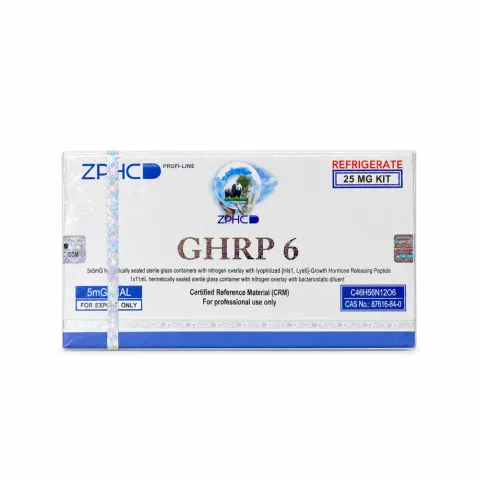
GHRP-6 available in Egypt
For research use onlyResearch products with the current store price and stock. The scientific information on this page describes published studies, not these products.
Authoritative Sources & Literature Registry
Regulatory dossiers, clinical trial registries, and published studiesCertain bulk drug substances for use in compounding that may present significant safety risks ↗
https://www.fda.gov/drugs/human-drug-compounding/certain-bulk-drug-substances-use-compounding-may-present-significant-safety-risks
The Prohibited List ↗
https://www.wada-ama.org/en/prohibited-list
GH-releasing hormone and GH-releasing peptide-6 for diagnostic testing in GH-deficient adults ↗
https://pubmed.ncbi.nlm.nih.gov/11030292/